Surge in Refugees Drives Increased Demand for Private Healthcare Services in Egypt
Ahmad Sabry
More than a year after the influx of refugees from Sudan to southern Egypt and from Gaza to the east, the number of foreigners in Egypt has risen to over 10 million people. This surge has had both positive and negative impacts across various sectors, but this report will focus on the healthcare sector.
In recent months, we have observed an increase in the number of refugees from various nationalities seeking services in the private healthcare sector. This has resulted in higher occupancy rates in this sector, facilitated by partnerships with charitable organizations.
The primary reason for refugees turning to private healthcare is that most of them are not registered with the United Nations High Commissioner for Refugees (UNHCR) in Egypt. This lack of registration excludes them from accessing free government services, as they are considered foreigners without legal residency.
As of the end of August, the number of refugees registered with the UNHCR in Egypt stood at 750,000, compared to the total figure announced by Foreign Minister Badr Abdel-Atty of 10 million.
This discrepancy, representing more than 13 times the officially registered number, has driven most refugees to seek assistance from private healthcare providers and charitable organizations, which have played a crucial role in delivering health services.
Throughout this year, several private laboratories and medical centers in Egypt have launched promotions aimed at attracting refugees, offering generous discounts in areas of Cairo, Giza, and Aswan.
In recent weeks, we observed numerous private clinics and medical centers advertising discounts specifically for Sudanese and Palestinian refugees on social media and in the streets, particularly in areas like Faisal and Mohandessin, as well as some regions in Cairo.
We visited a medical center in Al-Rehab City, Cairo, which offers promotions for refugees. We spoke to some refugees about their opinions on these offers, questioning whether they were genuine and beneficial or merely promotional gimmicks.
Mohamed Al-Fateh, a Sudanese refugee, mentioned that he received a 50% discount on consultation and tests, along with a 10% discount on medications. He noted that this was a significant help, especially given his financial struggles after fleeing the war last year.
He emphasized that the names of clinics offering discounts spread quickly among refugees on social media platforms.
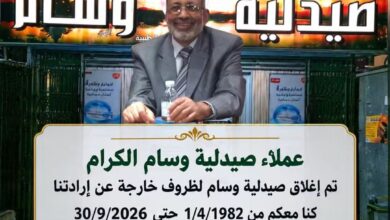
We found these advertisements on Twitter and Facebook; see the following images.
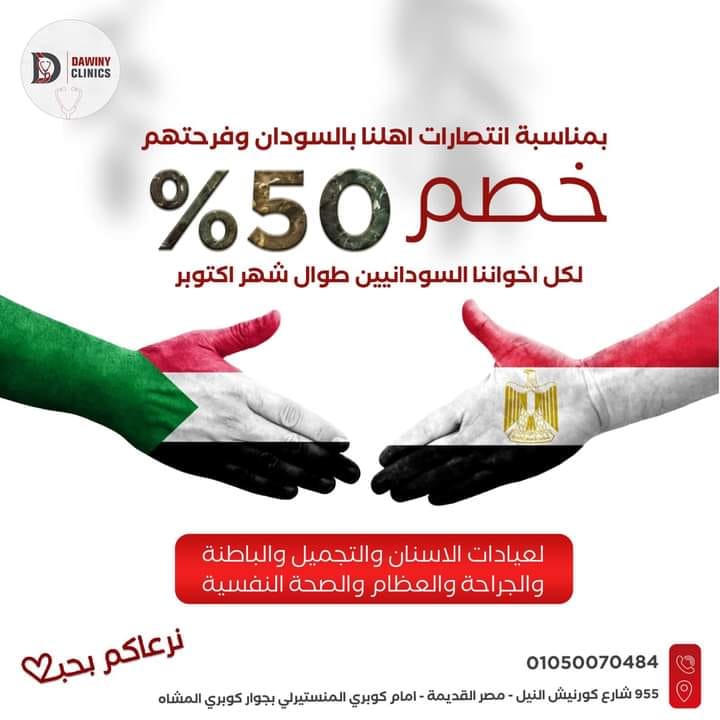
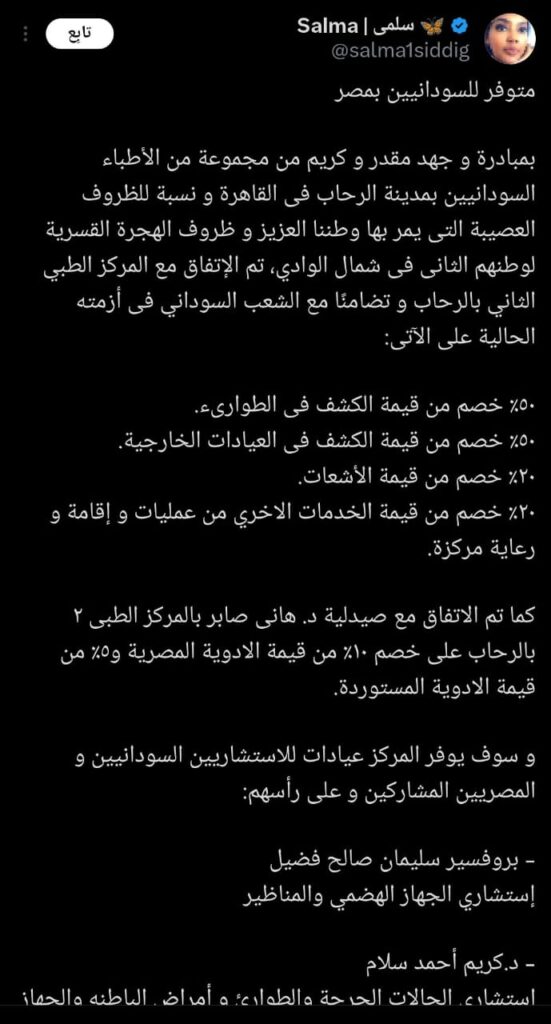
Our observations revealed that most patients visiting discount clinics were from poorer backgrounds, with many requesting the establishment of more charitable organizations to enable unregistered refugees to access health services directly.
Mamdouh Atta, whom we met at a medical center in Dokki, confirmed that he receives medical services through assistance from a local charitable organization that has a contract with the medical center to treat refugees.
We reached out to Dr. Ghada El-Ganzouri, Deputy of the Health Care Providers Chamber at the Federation of Egyptian Industries, who confirmed that medical centers have indeed benefited from the rising number of refugees in Egypt, particularly in the Dokki and Mohandessin areas of Giza compared to Cairo.
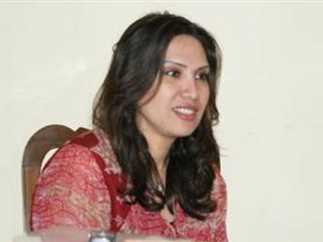
In statements to “Doctor News,” where she serves on the board of the El-Ganzouri Hospital, she mentioned that they have treated several Palestinians and Sudanese in collaboration with charitable bodies.
She noted that special discounts were offered to refugees, considering their circumstances fleeing war-torn regions in Sudan.
Our report indicates that most beneficiaries of these discounts are refugees from Palestinian and Sudanese nationalities.
Dr. Mohamed Salem, a lab owner in Aswan, southern Egypt, stated that he provides medical tests for Sudanese patients at cost price as a personal initiative, clarifying that many doctors are doing the same in nearby areas.
He emphasized that such initiatives foster goodwill among nations, adding, “They are our guests for a temporary period, and we must assist our guests.”
We also discovered initiatives from Sudanese doctors who have reduced consultation fees in collaboration with Sudanese charities. One such doctor, Mohamed Al-Jamal, a physician specializing in internal medicine, discussed these initiatives, emphasizing their importance due to the large number of refugee patients.
He added, “There is a decline in the number of officially registered Sudanese doctors in Egypt due to delays in security approvals for those wishing to open clinics or work locally. The crisis in Sudan necessitates expediting these approvals so that more Sudanese, whether doctors or patients, can benefit.”